
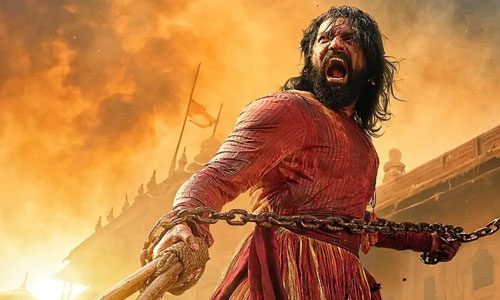
 The great Shivaji Maharaja’s life blazed with glory, and his untimely death struck Hindavi Swarajya like a tempest.
His son, Sambhaji Maharaja, walked a path shadowed by controversy—some caused by others, some by his own choices. Yet, his death became a turning point for Maratha power in Bharata, marking the beginning of Aurangzeb’s downfall and the slow collapse of the Mughal dynasty.
It is often said that a true warrior should aspire to live like Shivaji Maharaja and depart like Sambhaji Maharaja. One embodied 𝘿𝙝𝙖𝙧𝙢𝙞𝙘 𝙅𝙚𝙚𝙫𝙖𝙣—a life of righteousness—while the other embraced 𝙑𝙚𝙚𝙧 𝙈𝙖𝙧𝙖𝙣—a heroic sacrifice. Shivaji Maharaja was revered as 𝙅𝙖𝙣𝙖𝙩𝙖 𝙍𝙖𝙟𝙖, the beloved king of the people, while Sambhaji Maharaja was honored as 𝘿𝙝𝙖𝙧𝙢𝙖 𝙑𝙚𝙚𝙧, the fearless warrior of righteousness.
Aurangzeb, the villain in their story, loomed over both their lives. He spent his entire life lamenting Shivaji Maharaja’s escape—an event that sent tremors through the Mughal empire. Imagine the magnitude of that single escape! So, when he finally captured Sambhaji Maharaja, his fury knew no bounds. Yet, even in captivity, Sambhaji Maharaja’s resilience, unwavering courage, and fearless reslove only intensified Aurangzeb’s rage, unleashing the most demonic facets of his nature.
One of the greatest tragedies was that while the Marathas had once escaped from Aurangzeb’s stronghold, they could not avert Sambhaji Maharaja’s capture in their own homeland. Despite their valor, they failed to rescue him.
What followed was an unforgiving 20-year struggle for the Mughal army in the Maval region. Aurangzeb, the once-mighty emperor who ruled from Agra and Delhi, met his end in a makeshift camp near Ahmednagar. In his final days, he was haunted by Shivaji Maharaja’s escape and the Marathas steadfast resilience.
Shivaji Maharaja lived by the teachings of the Bhagavad Gita and the ideals of the Ramayana, leaving behind a legacy untouched by controversy. Sambhaji Maharaja, like Abhimanyu in the Mahabharata, knew how to break into the Chakravyuha but was ultimately deceived and killed through betrayal. Shivaji Maharaja held an unshakable principle—never to be captured and to live for the expansion of a noble cause. In contrast, Sambhaji Maharaja, despite his apparent disobedience toward his father, sacrificed his life for a greater purpose. His martyrdom rekindled the Maratha spirit, forging them into an unstoppable force against the Mughals.
Aurangzeb’s regret was profound. After Sambhaji Maharaja’s death, the Marathas became like air and space—elusive, relentless, and impossible to contain. They struck from every corner, granting the Mughals no relief. They embodied the warrior spirit proclaimed by Sri Krishna in the Bhagavad Gita (2.32):
“𝘖 𝘗𝘢𝘳𝘵𝘩𝘢, 𝘩𝘢𝘱𝘱𝘺 𝘢𝘳𝘦 𝘵𝘩𝘦 𝘒𝘴𝘩𝘢𝘵𝘳𝘪𝘺𝘢𝘴 𝘵𝘰 𝘸𝘩𝘰𝘮 𝘴𝘶𝘤𝘩 𝘧𝘪𝘨𝘩𝘵𝘪𝘯𝘨 𝘰𝘱𝘱𝘰𝘳𝘵𝘶𝘯𝘪𝘵𝘪𝘦𝘴 𝘤𝘰𝘮𝘦 𝘶𝘯𝘴𝘰𝘶𝘨𝘩𝘵, 𝘰𝘱𝘦𝘯𝘪𝘯𝘨 𝘧𝘰𝘳 𝘵𝘩𝘦𝘮 𝘵𝘩𝘦 𝘥𝘰𝘰𝘳𝘴 𝘰𝘧 𝘵𝘩𝘦 𝘩𝘦𝘢𝘷𝘦𝘯𝘭𝘺 𝘱𝘭𝘢𝘯𝘦𝘵𝘴.”
Kunti Devi, through Sri Krishna, had urged Yudhishthira to raise her sons as Veera Putras (𝘩𝘦𝘳𝘰𝘪𝘤 𝘴𝘰𝘯𝘴).
For those who seek a Dharmic life, Sri Krishna’s words in the Bhagvad Gita (8.7) impart the ultimate lesson: “Tasmāt sarveṣhu kāleṣhu mām anusmara yudhya 𝘤𝘩𝘢”— 𝘛𝘩𝘦𝘳𝘦𝘧𝘰𝘳𝘦, 𝘢𝘭𝘸𝘢𝘺𝘴 𝘳𝘦𝘮𝘦𝘮𝘣𝘦𝘳 𝘔𝘦 𝘢𝘯𝘥 𝘧𝘪𝘨𝘩𝘵.
We remain eternally indebted to our warrior kings and soldiers—both on the battlefield and in every realm of life—who lived for the great cause of Dharma and some sacrificed their lives for something far beyond personal gain.
– Govinda Das (ISKCON Member)

1 Comment
Jai… Well said prabhuji thankyou for inspiring us….