“All the world’s a stage,
And all the men and women merely players;
They have their exits and their entrances;
And one man in his time plays many parts,
His acts being seven ages.”
— As You Like It, 2.7
This speech by Jaques, in William Shakespeare’s As You Like It, goes on to detail the seven stages of a person’s life, from infancy to schoolboy, to lover, soldier, justice (middle age), and then from seniority to the type of old age that’s like a second childhood, where one is without teeth, eyes, taste, without everything.
There’s much debate about whether Shakespeare was Catholic or Protestant, but there’s a sense of pensiveness in the lines quoted above. This idea is taught deeply and intrinsically in Sanatan Dharma, in the Gita, its universality resonating with people everywhere, all the time.
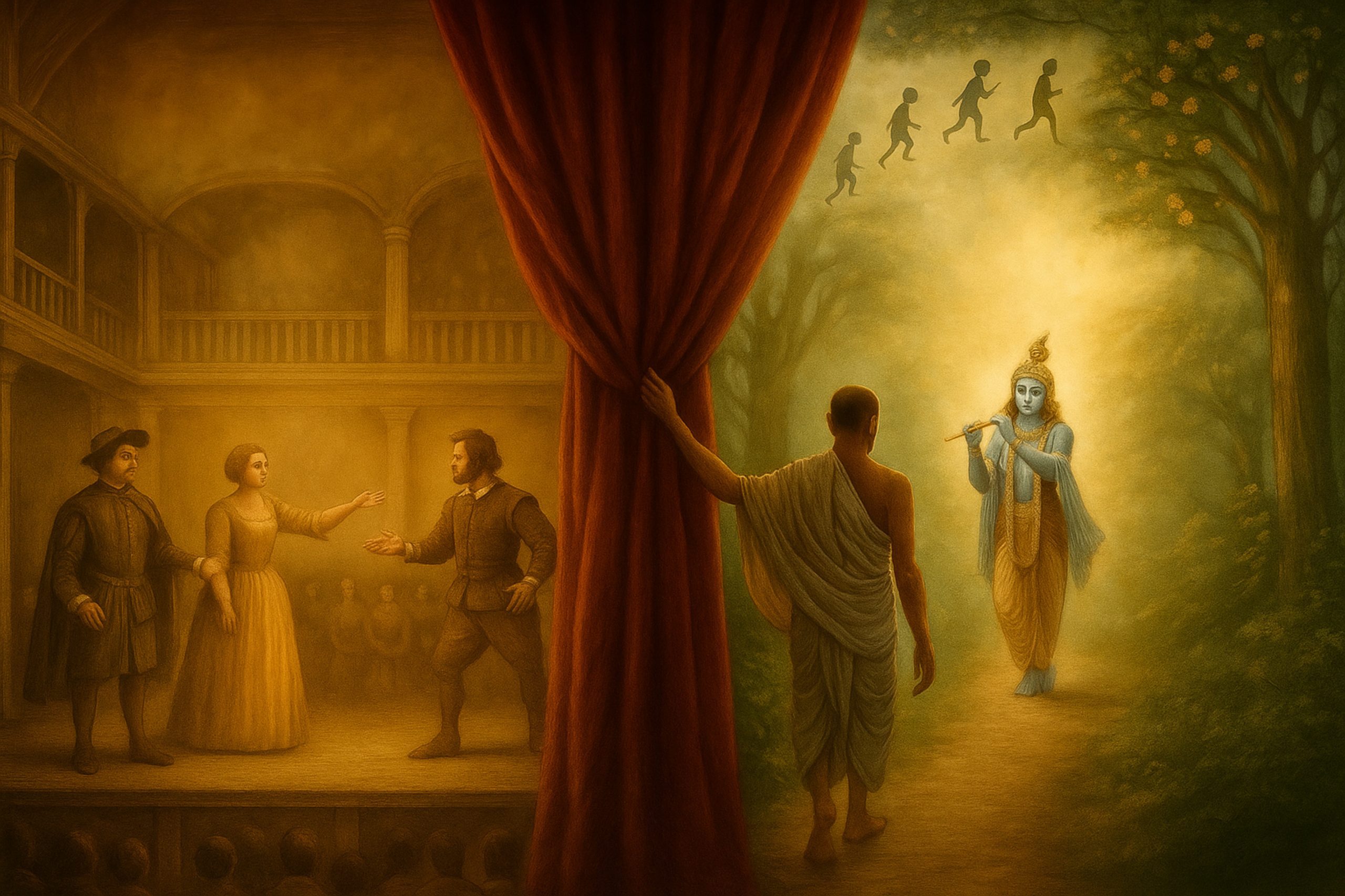
The first line says that the world we are living in is like a stage, it’s temporary and everything that happens here is a script unfolding dramatically and perfectly. Everything that happens is exactly as it should be. (Of course, Shakespeare has a character on stage narrating these lines, so you can see his affinity for puns.)
And all the people populating this stage are players — which is the Elizabethan word for actors. In our case, we also extend this consciousness to plants and animals. Shakespeare then goes on to say that each living being has their exits and entrances. By exits and entrances, he’s referring to their deaths and births. This line has the potential to be deeply profound. For one, he’s mentioned exits, or deaths, first, and entrances second. The people that are living now will die one day, exiting the stage. But then there’ll be an entrance. It hints at a belief in the cycle of rebirth, in the idea that after death, there’ll be birth again.
Then he goes on to talk about the different stages of a person’s life, categorising them into seven distinct phases. But then the conversation goes elsewhere as the play continues.
If there is a rebirth, what will it be like? And what are we supposed to do with these many births? Why are we here? Where are we supposed to go next? What’s our purpose?
Shakespeare, with deep thought and feeling, got us as far as a single person could. But for the questions that follow, one must turn to Krishna, to the Gita.
Yes, we are in fact trapped in the cycle of death and rebirth. We’ll escape it when we realise that everything on this plane of existence is temporary and ephemeral, so we’ll detach from the world and connect to Krishna. Our purpose is to recognise our position as a spirit soul, that’s yearning to return to Him.
As Krishna Himself explains:
“nānyatra mad bhagavataḥ
pradhāna-puruṣeśvarāt
ātmanaḥ sarva-bhūtānāṁ
bhayaṁ tīvraṁ nivartate”
(The terrible fear of birth and death can never be forsaken by anyone who resorts to any shelter other than Myself, for I am the almighty Lord, the Supreme Personality of Godhead, the original source of all creation, and also the Supreme Soul of all souls.)
— SB 3.25.41
– Aarushi Agrawal