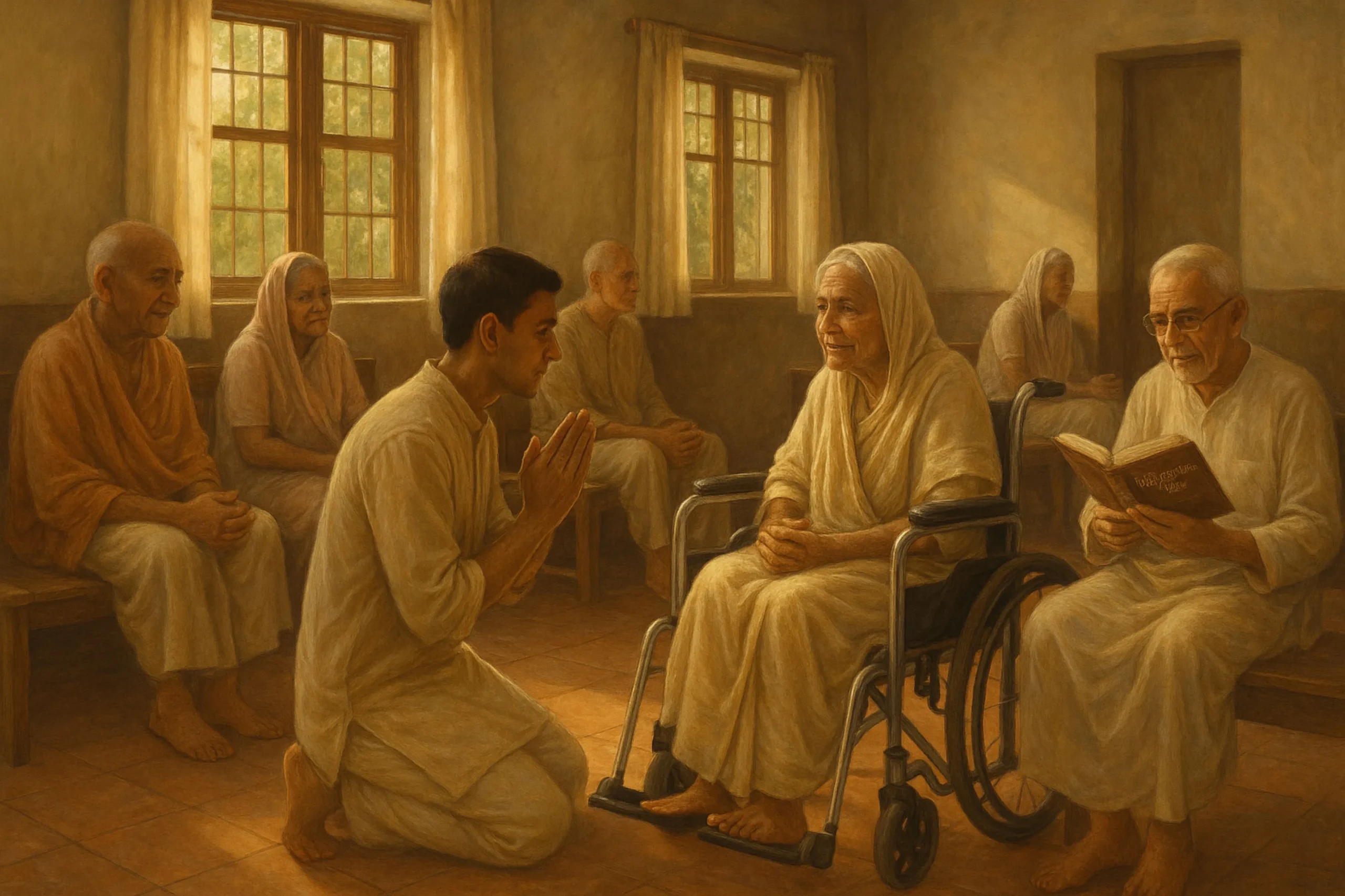
It’s sobering to see, in one place, more than thirty elderly people staying together — some helplessly, others reluctantly. When I visited their rooms and tried to connect with them, I realised this was not a normal event for them. My presence as an outsider felt unusual, as though even their own family members seldom visited. I saw one elderly lady approach the kind-hearted owner of the home, pleading with him to connect her to her son on the phone.
The owner, Prithviraj, started this noble initiative a few years ago to give back to society. Caring for thirty elderly souls is no small task — it demands compassion, patience, and spiritual stamina.
Interestingly, Prithviraj mentioned that it’s not always a story of abandonment. Sometimes the reality is more nuanced, not black and white. Often, it is genuine helplessness, the lack of proper facilities, or both family members being employed and unable to provide round-the-clock care, that compels them to bring their elders to such homes.
We met one elderly man being supported by two staff members as he tried to walk. His entire family had come to visit. They spent some time together and left. The old man was neither blissful that they came nor sorrowful that they left — he was indifferent, beyond both excitement and complaint.
Another visitor I met supplies resources and staff for sixteen such elderly homes across Mumbai and Pune. His words reminded me of Śrīla Prabhupāda’s reflection in a Bhāgavatam purport:
“Society becomes healthy when it cares for children, women, teachers (brāhmaṇas), cows, and the elderly.”
One of the greatest tragedies of our times is that we, as a society, have royally failed to empower these five pillars — and then dare to blame God for our collective suffering.
The Mahābhārata also reminds us that serving the elderly is a path to wisdom. In the Yakṣa Praśna, when Yudhiṣṭhira Mahārāja is asked how one develops wisdom, he replies — “By serving the elderly.”
Even Śrī Kṛṣṇa chastised Arjuna once, asking him, “Have you not served your elders?” — when Arjuna lost composure and tried to attack his own brother for insulting his Gāṇḍīva bow.
Today, the situation is quite the opposite. I have heard of “modern, sophisticated” schools that reject admission to children who live with grandparents, as if the presence of the elderly is a disqualification. What a disgrace! How can we even call such an institution a school? It is, in truth, a slaughterhouse — slaughtering the sensitivity of children from the very beginning, making them self-centred, convenience-driven, and culturally rootless.
A question naturally arises — What karma leads elderly people to be abandoned, made to feel orphaned in their final years?
The answer of Dharma-śāstra is profound, philosophical, and brutally practical. The scriptures expect that as one becomes free from family responsibilities, one must begin the Vānaprastha journey — a life of inward turning, inner detachment, and spiritual focus. The elderly are advised to reduce expectations from their children and gradually live a life oriented towards sāttvika solitude.
In earlier times, children would cry in separation as their parents chose to live independently, dedicating themselves to adhyātma (spiritual cultivation). Today, the trend is reversed — elderly parents want to remain deeply involved in family affairs, while children feel burdened and unempowered. Many children, though demanding independence, lack the maturity to manage it — leading to conflict, guilt, and eventual emotional separation.
This constant tug-of-war — expectations versus freedom — creates the modern nuclear family, where everyone is surrounded by artificial expectations and hidden guilt. Some escape this emptiness through parties, travel, and luxury, yet never find true fulfilment.
Through this visit, I developed a much clearer understanding of Vānaprastha — it is not total withdrawal, nor abandonment. It is a sacred balance: reducing involvement without rejecting the family; maintaining proximity while deepening detachment; engaging more in sādhana while contributing to the spiritual growth of society.
I remember many years ago visiting another elderly and children’s home in Mathurā. A saintly lady had started a unique project — placing 8 to 10 small girl children with two elderly women and a few support staff in each unit. The result was heartwarming: the elderly felt noticed and fulfilled, and the children received motherly and grandmotherly affection. They both healed and grew together.
There’s a beautiful echo of this in Vālmīki Rāmāyaṇa. When Sītā Devī came to Vālmīki’s āśrama, many women received her and took her to their section of the āśrama. These were not abandoned women; their speech, as recorded by Vālmīki, reveals confidence and empowerment — not helplessness.
Hence, there is an urgent need to establish spiritually centred elderly homes — or better yet, Vānaprastha Āśramas. These should be spaces of empowerment, not abandonment — where both parents and children feel dignity, not guilt. The elderly should find purpose, not pity; the young should feel gratitude, not burden.
This visit deepened my conviction in the timeless relevance of our śāstras. The image of the Pāṇḍavas walking to the Himalayas, Dhṛtarāṣṭra leaving home, and Vidura renouncing the palace became vividly alive and deeply instructive.
Ultimately, dignity in old age cannot be granted by others — it must be earned by oneself, through a consciousness rooted in service and surrender.
Family members can give affection and care, but true dignity arises when one enters the mindset of Vānaprastha — not merely depending on Kṛṣṇa, but serving Kṛṣṇa.
That indeed is the essence of Yoga — and the perfection of Bhakti Yoga.
— Govind Das (ISKCON MEMBER)