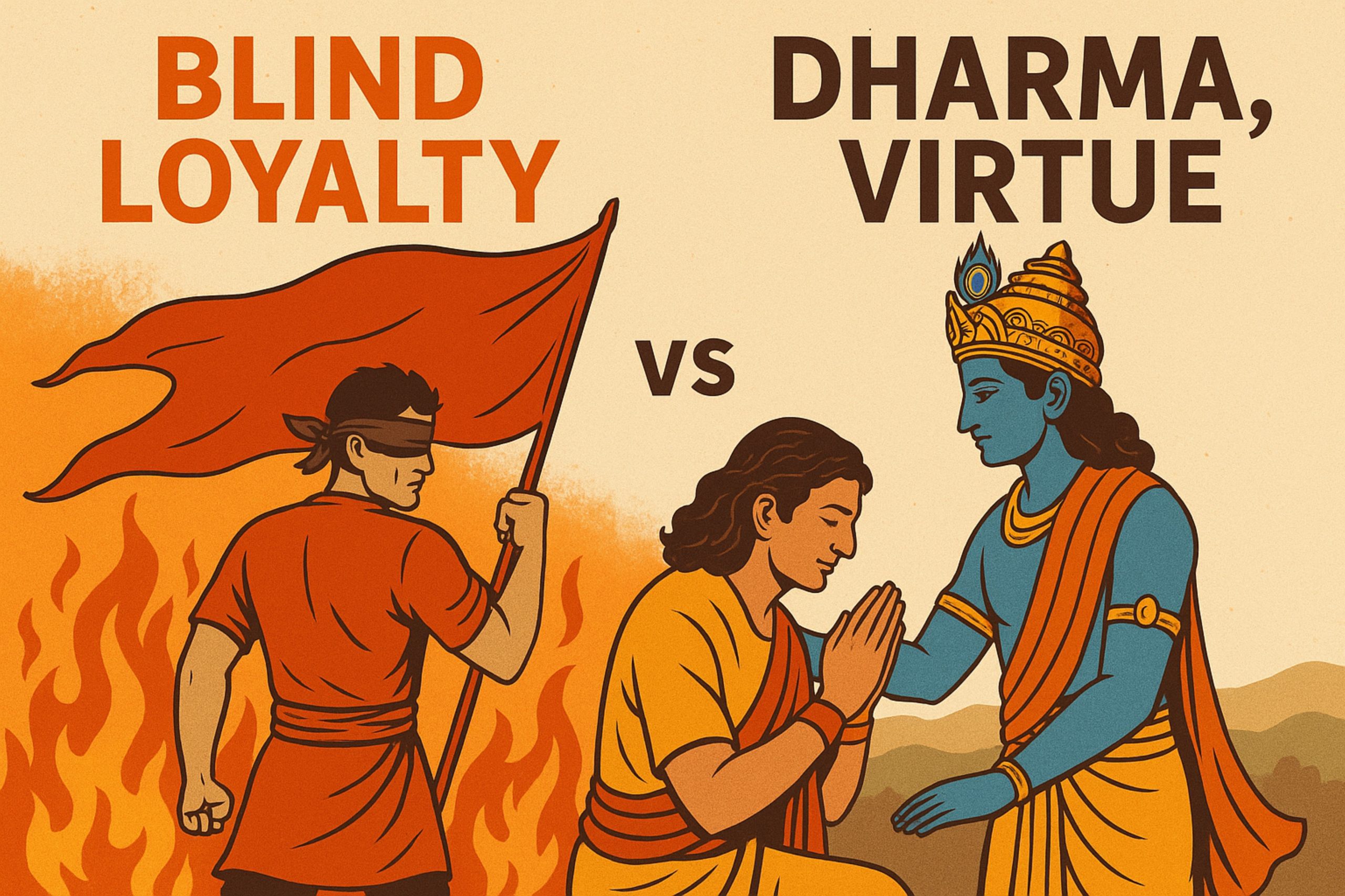
 Loyalty is, without question, a noble trait. Yet loyalty without reason, without logic, and without harmony with others? That’s a ticking time bomb. Blind loyalty easily morphs into violence toward others and intellectual stagnation within—a tragedy draped in virtue.
Ironically, we live in what’s supposed to be the age of reason and scientific progress. “𝘚𝘶𝘱𝘱𝘰𝘴𝘦𝘥” to be. Yet look around—radical loyalty tears us apart. Not just in religion, but in language chauvinism, celebrity cults, and ever-divisive nationalism. Yes, let’s all bow to our flags and fanbases while the world quietly burns. Toxic loyalty fragments communities under the illusion of superiority—and in that wreckage, Satya (truth) and Dharma (righteousness) are always the first to fall. Every time.
Take Darwin’s theory of evolution, for example. “𝘚𝘶𝘳𝘷𝘪𝘷𝘢𝘭 𝘰𝘧 𝘵𝘩𝘦 𝘧𝘪𝘵𝘵𝘦𝘴𝘵,” they say. But in these fanatical displays of loyalty, it feels more like a slide into tribalism. The so-called “educated,” “cultured,” and especially the “religious”—the elite fan club of some guru or ideology—often act so inhumanely, it defies belief. Yet that’s exactly what blind loyalty does: it hijacks reason, leaving behind only holy arrogance and no humanity.
𝘚𝘰𝘤𝘪𝘢𝘭 𝘋𝘢𝘳𝘸𝘪𝘯𝘪𝘴𝘮—a concept introduced by a British intellect—was badly misunderstood and even worse, weaponized. It emphasized survival of the fittest. Fine. But Dharma Shastra brings a counterbalance with “𝘫𝘪𝘷𝘰 𝘫𝘪𝘷𝘢𝘴𝘺𝘢 𝘫𝘪𝘷𝘢𝘯𝘢𝘮”—life feeds on life—but elevates the discussion further with sanskar (refinement) and sanskriti (culture), leading to human cooperation, not competition. The foundation of any meaningful loyalty must be built on values that uphold Dharma and Satya. Otherwise, loyalty becomes just another reason to be a sanctimonious bully.
Sanatana Dharma, in contrast, promotes peace and prosperity for all—even after rigorous sadhana and rituals, it ends with this gentle wish:
ॐ सर्वे भवन्तु सुखिनः । सर्वे सन्तु निरामयाः ॥
सर्वे भद्राणि पश्यन्तु । मा कश्चिद्दुःखभाग् भवेत् ॥
ॐ शान्तिः शान्तिः शान्तिः
A prayer from the Brihadaranyaka Upanishad, it wishes for universal happiness, health, and freedom from sorrow—not blind allegiance, nor hatred justified by identity.
When loyalty becomes an institution, a law, a cultural whip to crack over others’ backs—it loses its nobility. It becomes a threat. Loyalty is personal, inward, and individual. The moment it’s externalized and imposed, we start bleeding humanity.
Look at Sri Rama. He fought a reluctant war against Ravana, yet he wept with Ravana’s family. That’s dharma—not chest-thumping victory parades. Sri Krishna tried everything to prevent war. But blind loyalists like Dhritarashtra, and weakened, compromised men like Drona and Bhishma, enabled Duryodhana. And once it was all over, did Krishna go on a victory tour? No. He consoled Gandhari. He even accepted her curse, no retaliation, no justification. That’s what dharma looks like—justice with compassion.
But of course, those who “claim to know” are often the ones who have zero grasp of dharmic principles—the cultists, the loyalists, the ones who weaponize identity to mask their own intellectual emptiness.
Take today’s examples. The ridiculous explosion of ritvik philosophy, or the Kannada and Marathi linguistic warriors assaulting people for daring to speak other Indian languages. This isn’t loyalty—it’s petty, self-righteous insecurity disguised as culture.
I recently visited my old school. In the 1980s, Kannada and Marathi medium schools had over a thousand students. Now? Barely 200. Yet these so-called language warriors—who can’t even read classical texts in their own tongue and speak some English-laced hybrid—act like guardians of linguistic purity. The irony is unbearable.
Thankfully, I’ve been lucky—I studied in Kannada, still read it regularly, and speak fluently in Kannada, Marathi, and Hindi. I’ve seen Marwaris, Gujaratis, Sindhis embrace the local language wherever they go. But some of these regional purists? They drive away their own people and glorify English while pretending to defend their mother tongue. The stench of that toxic loyalty is hard to ignore.
Yet there’s hope. I know people running Kannada-medium schools where children—including non-Kannadigas—are thriving, learning classical Kannada alongside English. I’ve met students from Singapore, Mumbai, even America. They’re open, curious, respectful—not blinded by chauvinism.
Bangalore and Mumbai have always welcomed people from across Bharat. And yes, learning the local language when you live long-term is both sensible and enriching. Language should build bridges, not become barbed wire. Communities that embrace multilingualism thrive. Loyalists preaching linguistic fascism from their echo chambers? Not so much. They’re busy burning bridges in their own backyard.
There are hundreds of issues—religious, linguistic, cultural—where blind loyalists pose as protectors of identity. But beware of them. They’re the ones who can’t even speak, let alone live by, the wisdom of the Rigveda:
“𝘉𝘢𝘩𝘶𝘫𝘢𝘯𝘢 𝘴𝘶𝘬𝘩𝘢𝘺𝘢, 𝘣𝘢𝘩𝘶𝘫𝘢𝘯𝘢 𝘩𝘪𝘵𝘢𝘺𝘢 𝘤𝘩𝘢”
𝘍𝘰𝘳 𝘵𝘩𝘦 𝘩𝘢𝘱𝘱𝘪𝘯𝘦𝘴𝘴 𝘰𝘧 𝘵𝘩𝘦 𝘮𝘢𝘯𝘺, 𝘧𝘰𝘳 𝘵𝘩𝘦 𝘸𝘦𝘭𝘧𝘢𝘳𝘦 𝘰𝘧 𝘵𝘩𝘦 𝘮𝘢𝘯𝘺.
– Govinda Das (ISKCON Member)