When a British-based propagator of Sinhala Buddhist exclusivism planted the seeds of “Sinhalese as owners of Sri Lanka,” it ideologically fueled later pogroms against Tamils, even though he wasn’t alive when they occurred. His speeches and writings carried anti-Tamil venom, portraying Tamils (Hindus) as “invaders” from South India. This poison eventually birthed the LTTE separatist movement in Sri Lanka and culminated in the assassination of the Indian Prime Minister.
Many thousands were slaughtered in these man-made clashes. Today we see some politicians in Karnataka, Telangana, and Maharashtra spewing venom against North Indians and Gujaratis, demanding they learn Kannada, Telugu, or Marathi, even going so far as to threaten and in some cases physically assault them.
Hyper-linguistic and radical nationalism seen in the UK, Ireland, Australia, and now America is making linguistic minorities and outsiders feel unwelcome, unsafe, and fearful for their very security.
It is natural in human psychology to feel offended or threatened by so-called outsiders flourishing—even if not at one’s cost, the mere perception is often enough to fuel such a mindset.
As long as outsiders do not arrive in overwhelming numbers or toxic politicians do not incite hostility, people generally live harmoniously, with occasional skirmishes here and there being tolerated.
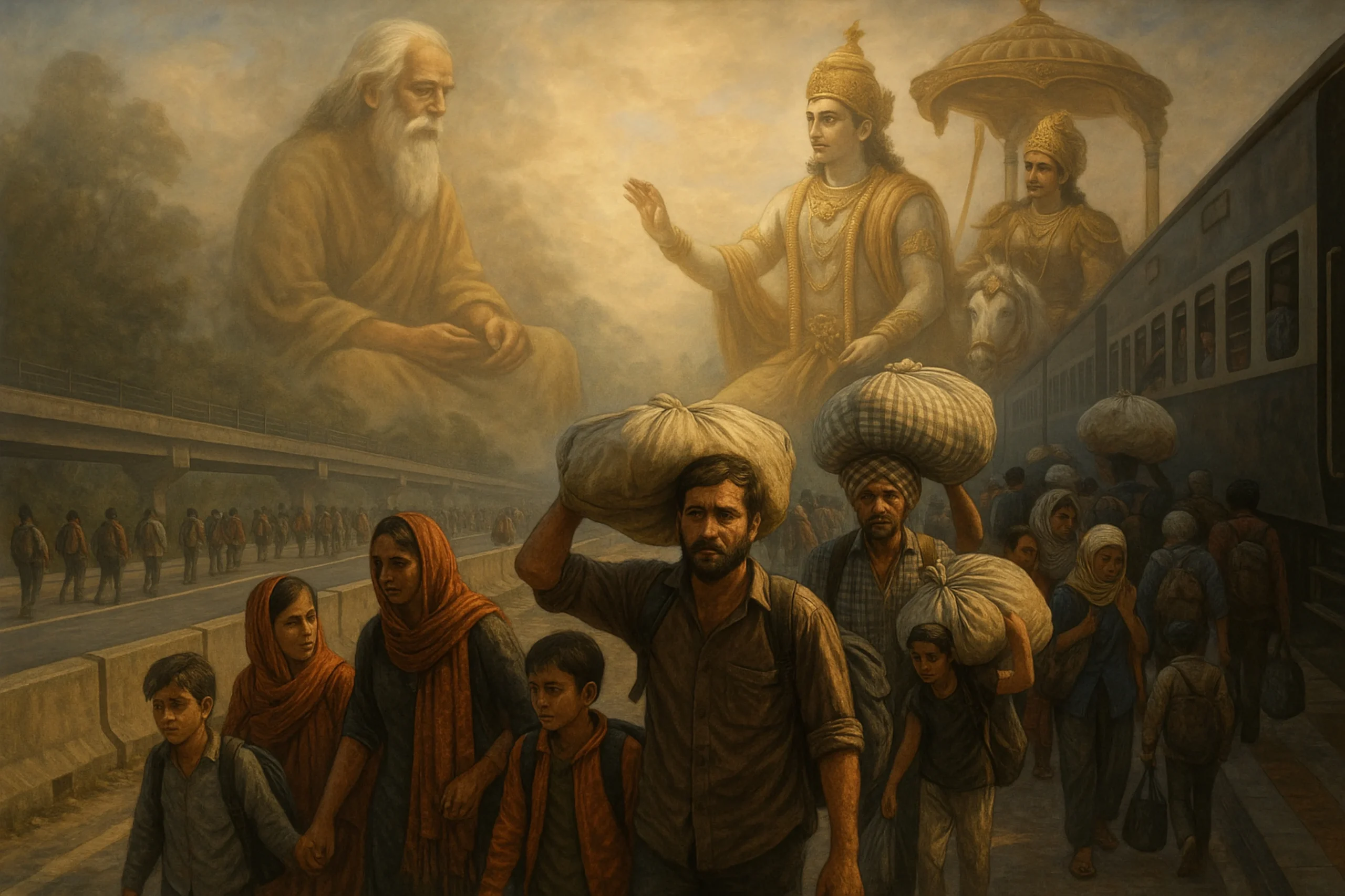
It especially becomes more vocal when outsiders migrate in large numbers to particular nations. Like Indians who migrated in large numbers to Europe, Australia and America—it was only a matter of time before locals felt offended and were instigated by radical white Christians fearing their land was being occupied and natives were being driven away. The Telugus, Kannadigas, Marathis, and others living abroad are facing the same heat along with all other Indians, while their relatives back in their native land in Bhārata must hopefully not support protests demanding people from other states be thrown out. For what goes around will surely come around.
Therefore, interestingly, the Mahābhārata and Rāmāyaṇa subtly discourage large-scale shifting of people to distant lands, which eventually leads to their dislodging. Be it Uganda, Myanmar, Kuwait, Ukraine, Iran, or Iraq—none have been spared. More than anyone, Indians have faced this predicament repeatedly, again and again. Certainly, it is not their fault alone; when the local economy cannot support them, migration to distant lands becomes inevitable.
It is a bitter reality of human existence that the slogan “the world is one family” is seldom practiced. As long as a community is seen as beneficial, people tolerate them—but the moment they feel threatened, the hosts begin treating the outsiders as enemies.
So, when Yudhiṣṭhira was asked by Yakṣa, “What is happiness?” the king replied without any philosophical display, giving a simple answer—happiness is to eat hot food in one’s own home, to be free from debt, and to work close to one’s own village or town. The corrupt and insensitive politicians, along with adharmic capitalists, bear much responsibility for forced migration. Yet, the ambitious tendencies of human beings also play their part in dislodging themselves.
Therefore, Śrī Kṛṣṇa was pleased to resettle the Yadavas, Vṛṣṇis, Bhojas, and Andhakas back in Mathurā. Yet even they eventually had to migrate again, this time to the distant land of Dvārakā.
In conclusion, migration is part of life and unsettling is also part of life—the time factor keeps oscillating between these two realities. It is the destiny of some groups to be caught in either side of this cycle. Yet those who, for whatever reason, remain and have the resources to stay stable are truly fortunate—and even more fortunate if they realize that their so-called native land is also a foreign land, for the eternal living being’s original home lies far beyond any physical homeland.
– Govind Das (ISKCON MEMBER)