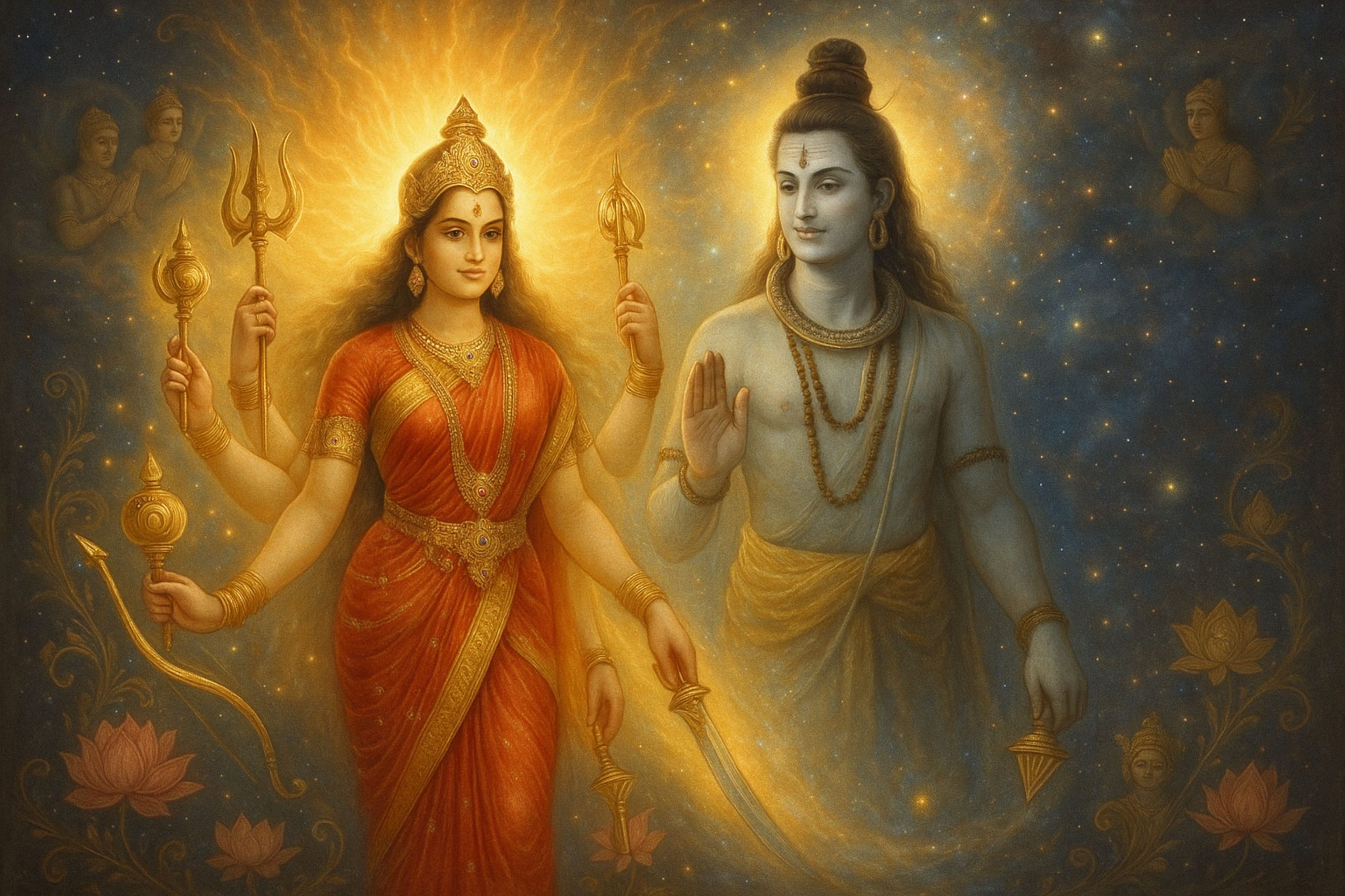
Śakti the feminine aspect and Śaktimān the masculine aspect are the eternal realities of godhood. She is energy, He is energetic; she is the flowing current, He is the shore that directs its course. She is poetry, He is prose; she is the subtle abstraction, He is the tangible reality. She is the sweetness of gentle speech, He is the power of thunderous voice. She is the enjoyed, He is the enjoyer. She is Durgā, He is Śiva. She is Lakṣmī, He is Nārāyaṇa.
This inseparable union of Śakti and Śaktimān is the very pulse of existence. Without Śakti, Śaktimān remains unmanifest; without Śaktimān, Śakti is boundless, unreachable by mortal grasp. Yet together, they move as one — the wellspring of creation, the strength of preservation, the fire of transformation. It is this profound balance that forms the foundation of dharma and the eternal rhythm of the cosmos.
Navarātri, therefore, is not merely a festival of devotion but a celebration of this eternal dance of divine polarity. For nine nights and ten days, dhārmik people honour the power of Śakti as she manifests in diverse forms —Durgā, the invincible protector; Lakṣmī, the bestower of prosperity; and Sarasvatī, the giver of wisdom. Each night unfolds as a step in the soul’s journey: from struggle to strength, from scarcity to abundance, and ultimately from ignorance to enlightenment.
During the divine appearance of Śrī Kṛṣṇa, Devī Yogamāyā also appeared. Interestingly, the appearance of Kālī Mā is observed on the very same day as that of Śrī Kṛṣṇa. Her manifestation is described beautifully in the Bhāgavatam: when she slipped from the hands of Kaṁsa, the goddess Durgā was adorned with flower garlands, anointed with sandalwood pulp, and dressed in excellent garments with ornaments of precious jewels. Holding in her hands a bow, trident, arrows, shield, sword, conch, disc, and club, she was praised by celestial beings Apsarās, Kinnaras, Uragas, Siddhas, Cāraṇas, and Gandharvas who worshipped her with all kinds of offerings. To this day, the Śāktas worship and honour her in different names and forms all over Bhārata Varṣa.
Especially during Navarātri, which stands as one of the most important dhārmik festivities, people not only celebrate the victory of good over evil but also learn that life itself is sustained by the harmony of Śakti and Śaktimān. To worship Śakti is to worship life’s energy, and to recognise Śaktimān is to embrace the unchanging truth that guides that energy. Together, they make existence sacred and complete.
The dhārmik tradition, whether worshipping Viṣṇu or Śrī Kṛṣṇa, Śiva or Rudra, always honours their counterpart—Lakṣmī or Rādhārāṇī, Pārvatī or Rudrāṇī. 𝙏𝙝𝙚𝙮 𝙖𝙧𝙚 𝙩𝙝𝙚 𝙚𝙨𝙨𝙚𝙣𝙘𝙚—𝙞𝙣𝙨𝙚𝙥𝙖𝙧𝙖𝙗𝙡𝙚 𝙖𝙣𝙙 𝙚𝙫𝙚𝙧-𝙥𝙧𝙚𝙨𝙚𝙣𝙩. 𝙏𝙝𝙚𝙞𝙧 𝙞𝙙𝙚𝙣𝙩𝙞𝙩𝙮 𝙞𝙨 𝙣𝙤𝙩 𝙢𝙚𝙧𝙚𝙡𝙮 𝙞𝙣𝙩𝙚𝙧𝙙𝙚𝙥𝙚𝙣𝙙𝙚𝙣𝙩 𝙗𝙪𝙩 𝙞𝙣𝙩𝙚𝙜𝙧𝙖𝙩𝙚𝙙—𝙤𝙣𝙚 𝙮𝙚𝙩 𝙙𝙞𝙛𝙛𝙚𝙧𝙚𝙣𝙩, 𝙙𝙞𝙛𝙛𝙚𝙧𝙚𝙣𝙩 𝙮𝙚𝙩 𝙤𝙣𝙚.
– Govind Das (ISKCON MEMBER)