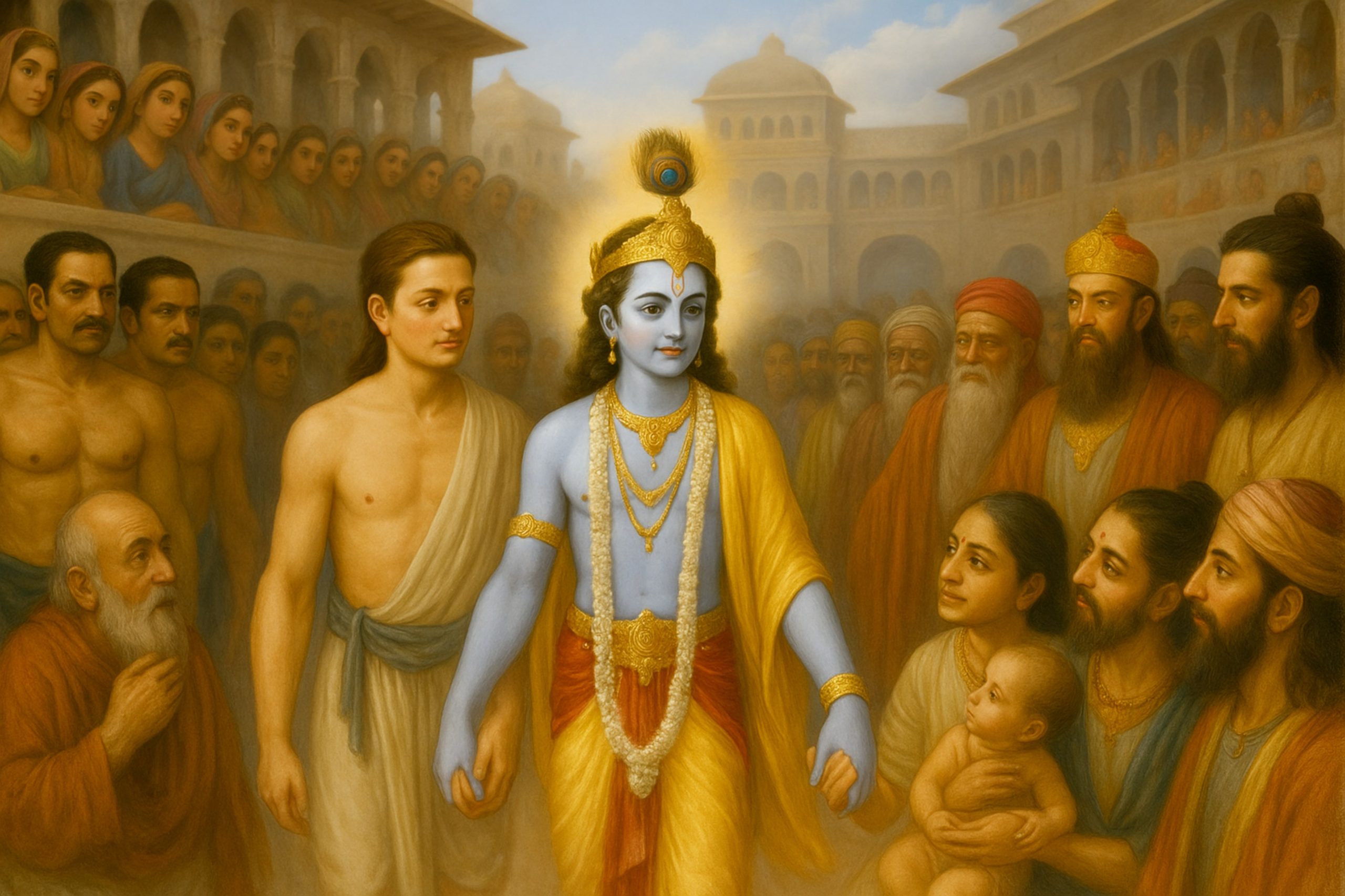
The various groups of people in the arena regarded Kṛṣṇa in different ways when He entered it with His elder brother. The wrestlers saw Kṛṣṇa as a lightning bolt, the men of Mathurā as the best of males, the women as Cupid in person, the cowherd men as their relative, the impious rulers as a chastiser, His parents as their child, the King of the Bhojas as death, the unintelligent as the Supreme Lord’s universal form, the yogīs as the Absolute Truth and the Vṛṣṇis as their supreme worshipable Deity.
(Śrīmad-Bhāgavatam 10.43.17)
𝙏𝙝𝙞𝙨 𝙬𝙖𝙨 𝙤𝙣𝙚 𝙤𝙛 𝙎𝙧𝙞 𝙆𝙧𝙞𝙨𝙝𝙣𝙖’𝙨 𝙥𝙪𝙗𝙡𝙞𝙘 𝙖𝙥𝙥𝙚𝙖𝙧𝙖𝙣𝙘𝙚𝙨 𝙗𝙚𝙮𝙤𝙣𝙙 𝙑𝙧𝙞𝙣𝙙𝙖𝙫𝙖𝙣𝙖.
The diverse populace of Mathurā beheld Him in their own ways—for it is natural that not all see through the same prism. One’s vision of Śrī Kṛṣṇa depends upon one’s mindset and saṁskāras. How one sees Him is certainly important, but what is equally remarkable is that they all saw Him.
Similarly, in the modern world, philosophers, devotees, politicians, poets, and profound yet disruptive thinkers all hold their own visions of Śrī Kṛṣṇa. Despite their varied mindsets and behaviors, each treasures a unique appreciation of Him. Let us keep these personalities veiled, yet bring forth the luminous spectrum of their conceptions of Śrī Kṛṣṇa.
𝙏𝙝𝙚 𝘿𝙚𝙫𝙤𝙩𝙚𝙚’𝙨 𝙫𝙞𝙨𝙞𝙤𝙣 :
Śrī Kṛṣṇa is Svayam Bhagavān — the Supreme Personality of Godhead, the fountainhead of all incarnations, forever absorbed in His eternal, transcendental pastimes. His words in the Bhagavad-gītā are absolute truth, His līlās in Vṛndāvana the pinnacle of reality — never mere allegory. To know Him and to serve Him with unalloyed love is the ultimate perfection.
𝙏𝙝𝙚 𝙨𝙤 𝙘𝙖𝙡𝙡𝙚𝙙 𝙎𝙥𝙞𝙧𝙞𝙩𝙪𝙖𝙡𝙞𝙨𝙩’𝙨 𝙫𝙞𝙚𝙬 :
Kṛṣṇa is the complete man — fully divine, fully human, effortlessly dwelling in love, war, play, and wisdom. He is the living harmony of life’s contradictions: the same hands that play the flute also hold the Sudarśana Cakra. Kṛṣṇa does not demand renunciation, but shows the art of living life fully, without guilt.
𝙏𝙝𝙚 𝙑𝙞𝙨𝙞𝙤𝙣𝙖𝙧𝙮 𝙛𝙧𝙤𝙢 𝙖𝙛𝙖𝙧 :
One great thinker, raised far from the land of Dharma yet drawn by his inner calling to India, saw Kṛṣṇa as both the inner divine guide (Antaryāmin) and the cosmic upholder of dharma. In the Gītā, He reveals the yoga of action and surrender to the Divine Will, embodying supramental consciousness that directs humanity’s evolutionary destiny.
𝙏𝙝𝙚 𝙋𝙤𝙚𝙩’𝙨 𝙆𝙧𝙞𝙨𝙝𝙣𝙖 :
Kṛṣṇa is the eternal beloved, the living symbol of divine love, most vividly revealed in the Rāsa Līlā. For the poet, He is less the strategist of battle and more the melody of the soul, the longing of Rādhā — love as the sacred bridge between human and divine.
𝙏𝙝𝙚 𝙑𝙚𝙙𝙖𝙣𝙩𝙞𝙨𝙩-𝙣𝙖𝙩𝙞𝙤𝙣𝙖𝙡𝙞𝙨𝙩’𝙨 𝙆𝙧𝙞𝙨𝙝𝙣𝙖 :
Kṛṣṇa is the perfect teacher of courage and strength. The Gītā is His gospel of fearless action (abhayam). He is revered as statesman, warrior, philosopher, and friend — the one who inspired Arjuna to rise above weakness and act for the welfare of the world.
𝙏𝙝𝙚 𝙋𝙧𝙖𝙜𝙢𝙖𝙩𝙞𝙘 𝙋𝙤𝙡𝙞𝙩𝙞𝙘𝙞𝙖𝙣’𝙨 𝙆𝙧𝙞𝙨𝙝𝙣𝙖 :
A worldly, westernized politician saw Kṛṣṇa as a complex figure — partly tribal hero, partly philosopher. He liked the Gītā’s call to duty, but read it more as philosophical allegory than literal divine revelation. He admired Kṛṣṇa’s diplomacy and strategy.
𝙏𝙝𝙚 𝙨𝙮𝙢𝙗𝙤𝙡𝙞𝙘 𝙥𝙤𝙡𝙞𝙩𝙞𝙘𝙞𝙖𝙣’𝙨 𝙆𝙧𝙞𝙨𝙝𝙣𝙖 :
Another political leader, stubborn about symbolism in scripture, interpreted Kṛṣṇa metaphorically. For him, Kurukṣetra was an inner battlefield, and Kṛṣṇa’s call to fight was about conquering inner evils. He regarded Kṛṣṇa as the divine friend and charioteer, guiding the soul toward truth.
𝙏𝙝𝙚 𝙆𝙞𝙣𝙜’𝙨 𝙆𝙧𝙞𝙨𝙝𝙣𝙖 :
One of the greatest kings of Bhāratavarṣa saw Kṛṣṇa as the living example of dharma-yuddha — waging war for righteousness with wisdom and moral purpose. He even modeled some of his political strategies on Kṛṣṇa’s diplomacy and unconventional war tactics.
𝙒𝙚𝙨𝙩𝙚𝙧𝙣 𝙋𝙝𝙞𝙡𝙤𝙨𝙤𝙥𝙝𝙚𝙧𝙨 𝙖𝙣𝙙 𝙒𝙧𝙞𝙩𝙚𝙧𝙨 :
A Philosopher: Kṛṣṇa as the harmonious integration of beauty, strength, and wisdom — “the most complete man in history.”
Another Philosopher: Kṛṣṇa in the Gītā as teacher of perennial philosophy — showing unity with the Divine through selfless action.
A Great Psychologist: Kṛṣṇa as the archetype of the Self — uniting opposites (playful and deadly, tender and ruthless) within a single personality.
A Dramatist: Kṛṣṇa as a universal figure of joy and divine play, transcending sectarian boundaries.
The attractiveness of Śrī Kṛṣṇa’s personality surpasses all human understanding; in some way, every heart is seeking Him. For most, He is Supreme Bhagavān — yet also friend, philosopher, and the object of all devotional service.
𝘈𝘴 𝘒𝘳𝘪𝘴𝘩𝘯𝘢 𝘴𝘢𝘺𝘴 𝘪𝘯 𝘵𝘩𝘦 𝘉𝘩𝘢𝘨𝘢𝘷𝘢𝘥 𝘎𝘪𝘵𝘢 ( 7.16 ) :
“O best among the Bhāratas, four kinds of pious men begin to render devotional service unto Me – the distressed, the desirer of wealth, the inquisitive, and the one searching for knowledge of the Absolute.”
Elsewhere, He displays supreme magnanimity — welcoming all to approach Him in their own way. He is the original liberal and flexible aspect of God, found in no other conception of the Divine. This is Sanātana Dharma manifested in living form.
𝘏𝘦 𝘉𝘦𝘨𝘪𝘯𝘴 :
“Just fix your mind upon Me, the Supreme Personality of Godhead, and engage all your intelligence in Me. Thus you will live in Me always, without a doubt.” ( BG 12.8 )
𝘐𝘧 𝘰𝘯𝘦 𝘤𝘢𝘯𝘯𝘰𝘵 𝘥𝘰 𝘵𝘩𝘪𝘴 :
“O Arjuna, if you cannot fix your mind upon Me without deviation, then follow the regulative principles of bhakti-yoga. In this way develop a desire to attain Me.” ( BG 12.9 )
𝘐𝘧 𝘴𝘵𝘪𝘭𝘭 𝘯𝘰𝘵 𝘳𝘦𝘢𝘥𝘺 :
“If you cannot practice the regulations of bhakti-yoga, then just try to work for Me, because by working for Me you will come to the perfect stage.” ( BG 12.10 )
𝘐𝘧 𝘦𝘷𝘦𝘯 𝘵𝘩𝘢𝘵 𝘪𝘴 𝘥𝘪𝘧𝘧𝘪𝘤𝘶𝘭𝘵 :
“If you cannot work in this consciousness of Me, then act giving up all results of work, and try to be self-situated.” ( BG 12.11 )
And if one is not interested in Him directly, but can live a dhārmic life even that is appreciated, without condemnation.
𝘍𝘪𝘯𝘢𝘭𝘭𝘺 𝘏𝘦 𝘥𝘦𝘤𝘭𝘢𝘳𝘦𝘴 :
“If you cannot take to this practice, then engage yourself in cultivating knowledge. Better than knowledge is meditation, and better than meditation is renunciation of the fruits of action, for such renunciation brings peace.” ( BG 12.12 )
Thus, Śrī Kṛṣṇa is vast as the sky, fluid as Mother Gaṅgā, unshakable as the Himalayas — embracing all ideas while always offering paths for growth. He is the Deity in the temple, receiving all: bhaktas, the inquisitive, the doubtful, the skeptical — all who partake of His prasāda and grace.
Śrī Kṛṣṇa Janmāṣṭamī ki Jai !!
– Govind Das (ISKCON MEMBER)