Long before science began exploring the mysteries of atomic energy and cellular life, Śrīla Vyāsadeva had already recognised their deeper nature and implications. In the Mahābhārata, he is not merely a visionary but a divine compiler—an unseen force who dissolves chaos through wisdom.
The atom is the smallest physical particle, yet it holds one of the most extraordinary systems known to existence. Thus, the Upaniṣad declares, “Every unit emanating from the Complete is complete in itself.” Those who have studied or experienced the atom remain captivated by its mystery. Even modern scientists stand silenced before the profound depth it reveals.
A cell is a living micro-organism living within this body. A single, tiny cell holds the power to be transformed into a fully developed, living entity. Simply thinking about it brings goose bumps. It is yet another fascinating complexity of creation.
Anything connected to nature, when studied with the right approach, has the power to fascinate. How it is created, how it functions—these invoke wonder. But why it works, what its purpose is, or who set it into motion—these deeper questions, when pondered and contemplated, offer glimpses of reality. And in those glimpses, gratitude is born. How gives rise to fascination; why gives rise to gratitude. Together, they elevate us into more refined beings.
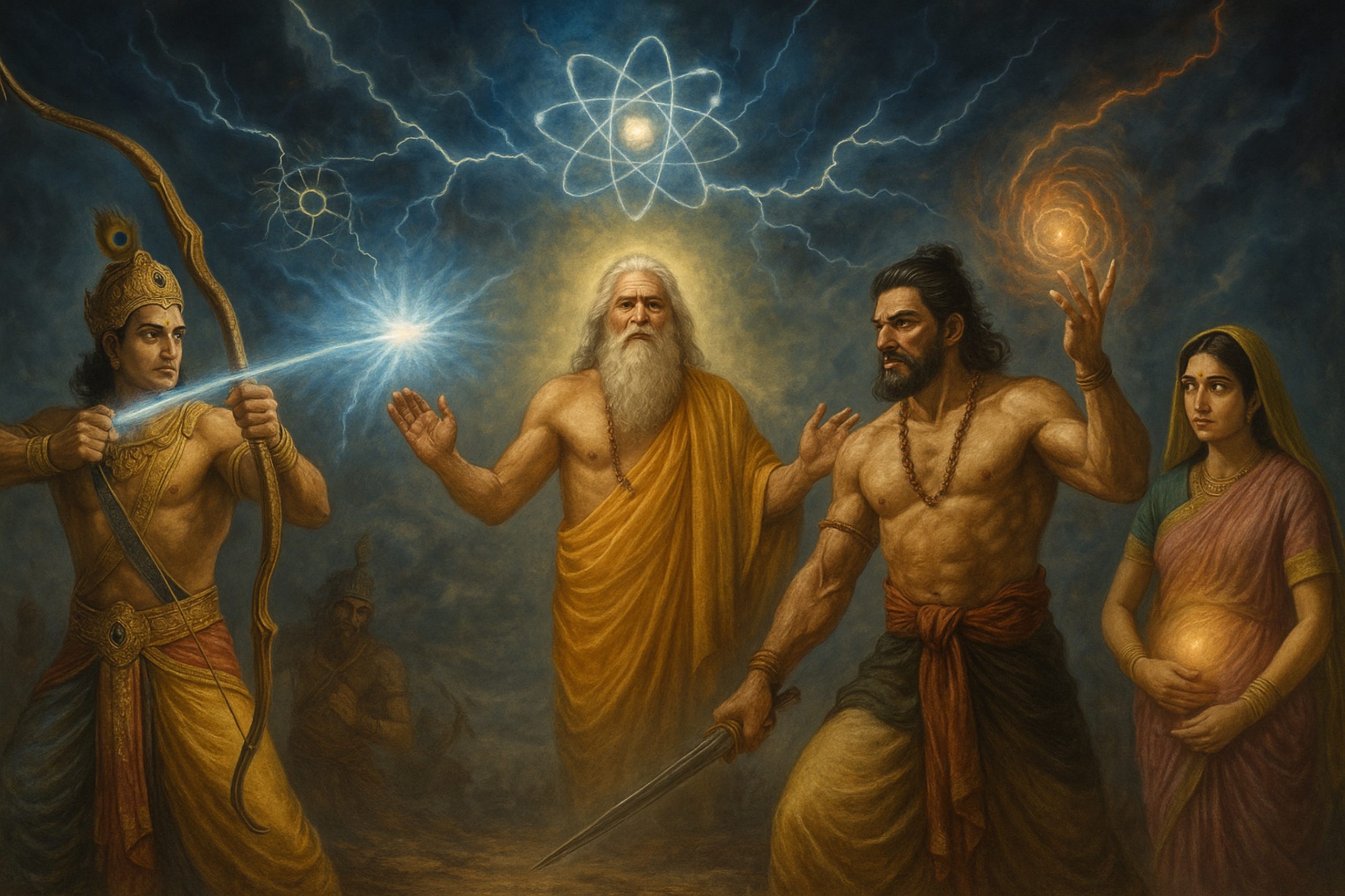
In the Mahābhārata, it was Śrīla Vyāsadeva who addressed the deeper truths behind the atom and the cell. He stopped the release of the Brahmāstra by Arjuna and Ashwatthāmā. Vyāsadeva warned both warriors about the destructive power of the Brahmāstra—the ultimate atomic explosion.
By Vyāsadeva’s grace, the destruction of the universe was halted—but the reckless Ashwatthāmā redirected the Brahmāstra toward Uttarā’s womb. Yet, Kṛṣṇa protected the life of Parīkṣit, the last surviving heir of the Pāṇḍavas.
Gandhari once lost her patience upon hearing the news of Kunti giving birth to Yudhiṣṭhira. In a moment of frustration, she struck her belly, resulting in a lump of flesh emerging from her womb. It was Vyāsadeva, by his divine insight and energy, who divided that mass into one hundred sons. At each turning point, his role was not merely supportive—it was transformative.
The cell and the atom were once used in a constructive and meaningful way. They supported each other’s growth. Of course, this harmony was later misused by Duryodhana and his party. Today, modern progress is tampering with both the atom and the cell. while its constructive use remains unexplored. The fully formed cell is at times brutally aborted. In other cases, the cell is genetically modified in an attempt to make it survive forever—so that man may seek immortality through science. Yet, the same science uses atomic energy to destroy everything created within a fraction of a second.
When the atom and the cell move in conflicting directions, the presence of balanced wisdom—like that of Vyāsadeva—becomes essential for the protection of the human race. Without such guidance, we risk following the path of Ashwatthāmā—manipulating power without understanding its purpose.
Śrīla Vyāsadeva stands not only as a compiler of scriptures but as a quiet force of discernment—guiding humanity through crossroads where power meets purpose. In an age where knowledge advances faster than wisdom, his presence remains a timeless reminder: true progress rests not in invention alone, but in intention shaped by dharma.
– Govind Das (ISKCON MEMBER)