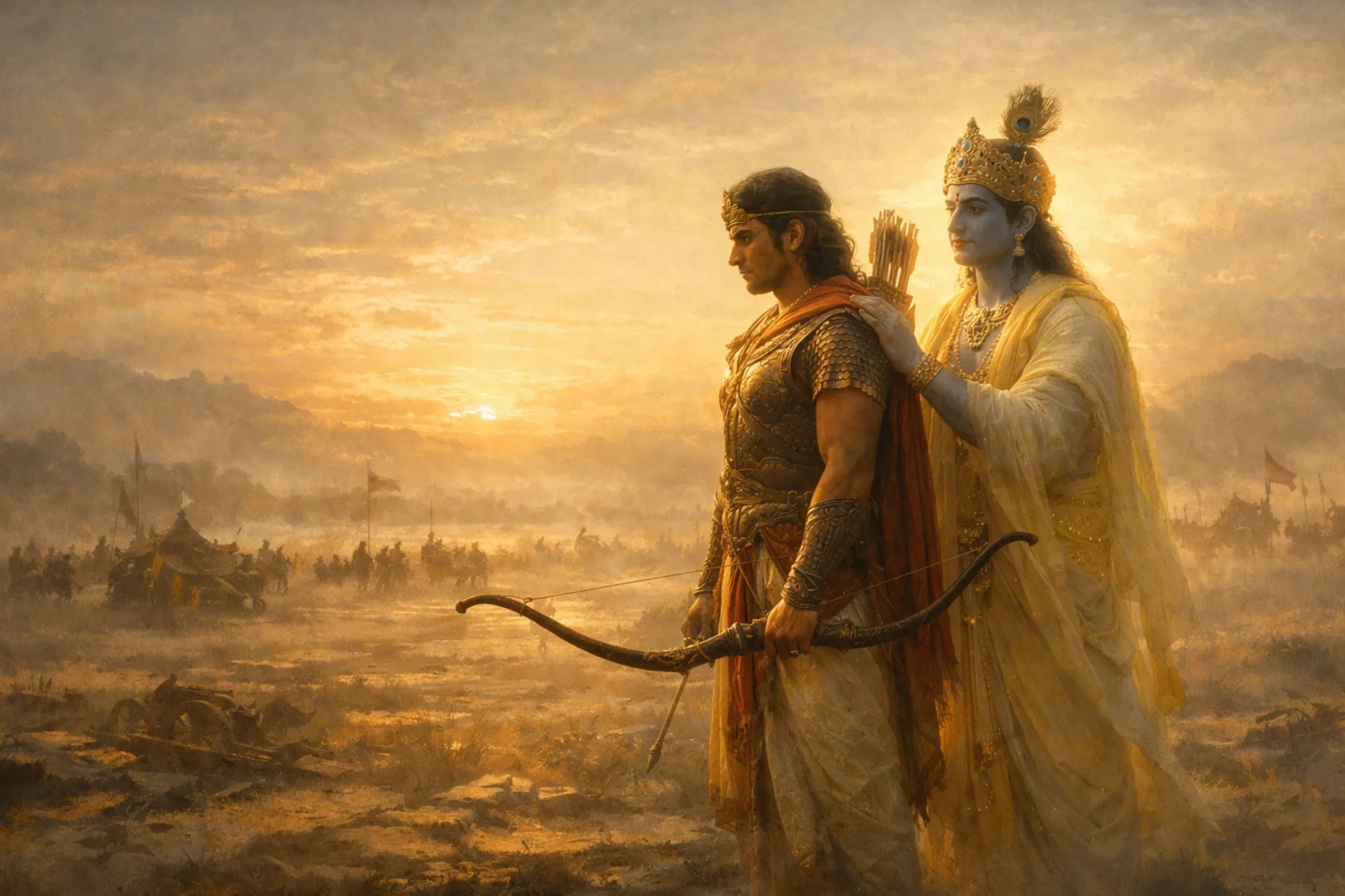
Practising the core teachings of the Bhagavad Gita was already embedded in the Pandavas’ psyche from early life. Sri Krishna later gave voice to those very principles for Arjuna in a language that was crisp and arresting—new in expression, yet grounded in eternal common sense—which the Pandavas were already following as a way of life. On the battlefield of Kurukshetra, however, Arjuna faltered in applying what he already knew, overwhelmed by the fear of losing those dear to him.
Unfortunately, when the Gita is taught today, people often become rigid in rituals and vows. Many drift into indifference toward their duties and responsibilities. People highlight differences between schools of thought, mistaking that for depth, while the real purpose—acting according to one’s disposition, preserving one’s legacy (svadharma), and contributing to loka-saṅgraha—remains untouched.
Even the very idea of surrender becomes distorted: abandoning one’s responsibilities and shifting the burden onto Krishna is taken as surrender, rather than offering Him the results of one’s rightful action.
Thus, the lives of the Pandavas—those for whom the Gita was spoken—offer the best example of living the Gita both before and after hearing it. In truth, nothing fundamentally changed in Arjuna. Hearing Krishna simply renewed his perspective. He returned to his duty as a warrior, strengthened and clarified, because he had always lived what he heard—only now it stood before him anew. For him, hearing and implementing the Gita was immediate; there was no delay.
For the Pandavas, śaraṇāgati meant acting according to their nature in good and bad times alike. Their surrender did not promise an easy life; it meant the ability to face difficult situations with clarity. They understood that bhakti does not alter the nature of the world. The Gita transforms perspective, not the fundamental laws of nature or human behaviour. Refining human values without opposing nature’s laws—this is the Gita’s greatest contribution.
Arjuna remained a warrior before and after the Gita. Acting merely from emotion, it is easy to shoot an evil Duryodhana, but impossible to fight Bhishma or Dronacharya. Yet even they stood on the side of adharma. Emotions have their place, but duty stands above them. A good person may uphold duty only as long as it does not hurt any beloved. But dharma goes beyond personal feeling—it is justice-centric, society-centric, and nature-centric. Surrendering to God is not a way to avoid these demands; it is the strength to face them despite the difficulty.
Therefore, the Pandavas embody the ideal of the rājarṣi: externally engaged in dharmic action—whether punishing or rewarding—yet internally grounded in dedication, reverence and magnanimity. Their treatment of Dronacharya, and later even Ashvatthama who killed their sons, shows this clearly. External duality with internal stability—this is the hallmark of the Pandavas’ character.
So, the Gita is better understood by studying the lives of the Pandavas under the guidance of a Guru who knows how to harmonize worldly duty with transcendental purpose.
— Govind Das (ISKCON MEMBER)